

The train that moves like a bird
As Japan’s high-speed Shinkansen trains became faster, engineers encountered an unexpected problem. When trains exited tunnels, they produced a loud noise known as the “tunnel boom,” caused by sudden changes in air pressure. This noise disrupted nearby communities and revealed a deeper design challenge associated with how the train transitions between open-air and confined spaces. Solving this problem required more than incremental adjustments; it required rethinking how the train interacts with air at high speed.
The breakthrough came from engineer Eiji Nakatsu, who was a birdwatcher. He studied the kingfisher, a bird that dives from the air into water with minimal splash despite the density difference between the two environments. Its long, pointed beak enables a smooth transition, reducing resistance and pressure disruption. Engineers translated this principle into the design of the train’s front end, creating a longer, more streamlined nose inspired by this bird’s unique beak.
The redesigned nose reduces the “boom” effect when exiting tunnels. This improved aerodynamic form allows trains to travel faster while using less energy. Modern long-nose Shinkansen trains, such as the E5 series, can reach speeds of around 320 km/h, or about 200 mph while improving efficiency by roughly 10 to 15 percent. Experimental models like the ALFA-X have been tested at speeds approaching 400 km/h (250 mph).
This evolution shows that the most significant performance improvements often come from a single, quiet observation of the natural world. By simply emulating the kingfisher’s beak, engineers solved a complex problem of physics, proving that nature had already perfected the design for smooth, quiet, high-speed travel.
Read more here: asknature.org
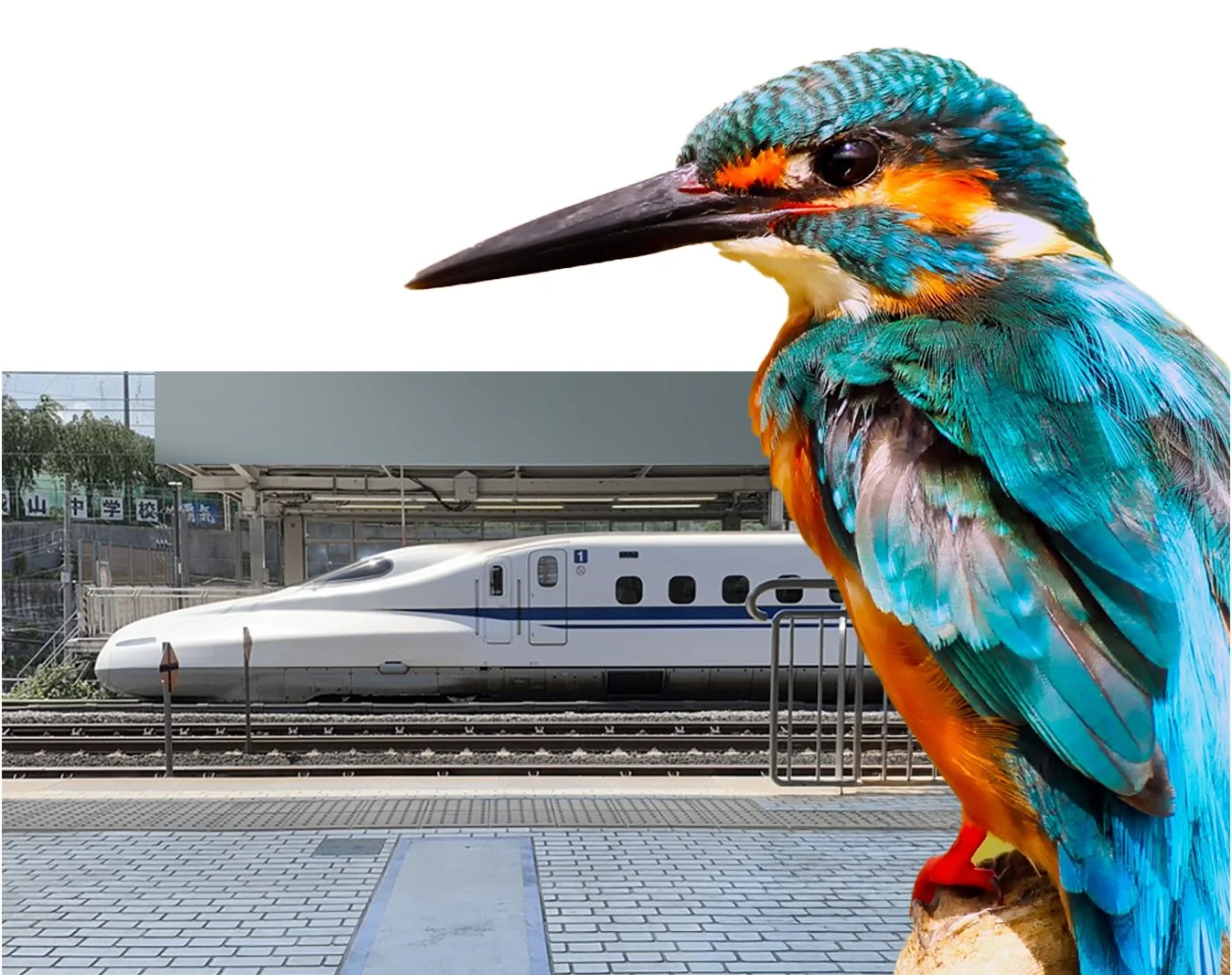
Shinkansen nose design inspired by the Kingfisher’s beak.