Can We Design Products That Improve as They Grow?
In nature, the most successful systems do not choose between development and growth - they pursue both simultaneously. Development refers to increasing complexity, capability, and sophistication, while growth involves expansion in size or scale. The Life’s Principle “Integrate Development with Growth” reminds us that true optimization occurs when strategies support both processes at once: moving from simple to complex while continuously building capacity and encouraging advancement at every stage.
Nature's Example: The Beehive
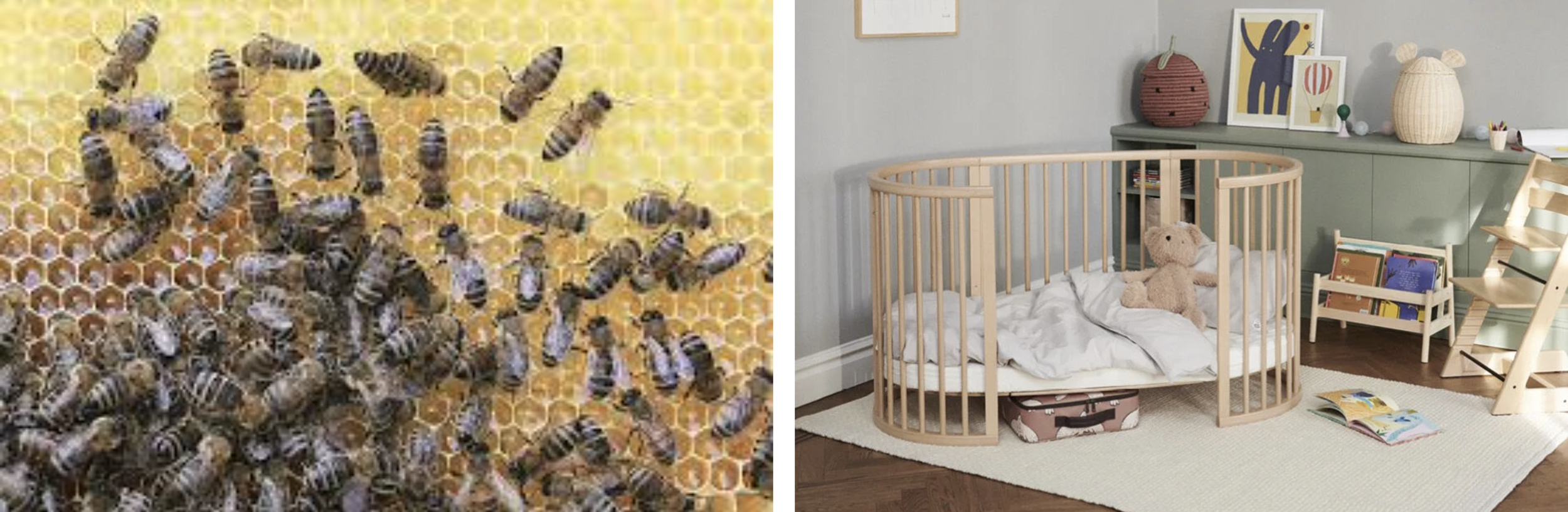
Bees are master builders that seamlessly integrate development with growth. As the colony expands, they construct hexagonal cells that form an exceptionally strong natural shell structure. The honeycomb functions as a three-dimensional architecture that maximizes both structural strength and material efficiency.
The results are remarkable: a comb made from only 40 grams of wax can support approximately 1.8 kilograms of honey—a strength-to-weight ratio of about 45:1. Through this strategy, bees invest in structures that advance both structural sophistication and colony capacity at the same time. As the hive grows larger, it also becomes stronger and more complex, demonstrating how development and growth can reinforce one another. asknature.org
Human Design Example: Stokke Convertible Crib
The Stokke convertible crib system illustrates this principle by evolving alongside the child from birth through approximately age ten. At the earliest stage, the crib is compact, nest-like, and oval-shaped - an environment carefully scaled to the needs of a newborn. As the child grows, the bed adapts accordingly: the mattress height can be lowered for safety, the structure can be opened to accommodate a larger body, and the configuration can be modified over time without replacing the core components.
This design approach acknowledges an important developmental reality: children often form strong emotional attachments to their familiar sleeping environments, making transitions from crib to toddler bed difficult. By providing conversion kits that allow the bed to transform gradually, Stokke aligns the product with the child’s developmental trajectory. The result is a sleeping environment that evolves in complexity and scale alongside the child, supporting continuity, comfort, and long-term use. stokke.com