

How to Sense Light Without Eyes?
Distributed vision in the brittle star
When we think about vision, we picture eyes. Whether it's a human eye, the compound eyes of an insect, or the large eyes of an owl, we tend to assume that seeing requires a dedicated organ.
Nature, however, often solves the same challenge in ways we might never have imagined. If we take the time to observe carefully, we can learn much from them.
The brittle star, a close relative of sea stars, doesn't have eyes in the way we typically think of them. Instead, it has evolved a distributed light-sensing system built directly into the armored plates that cover its arms. Rather than relying on a single organ, microscopic optical structures work together to help the animal sense changes in light, detect movement, and respond quickly to potential danger.
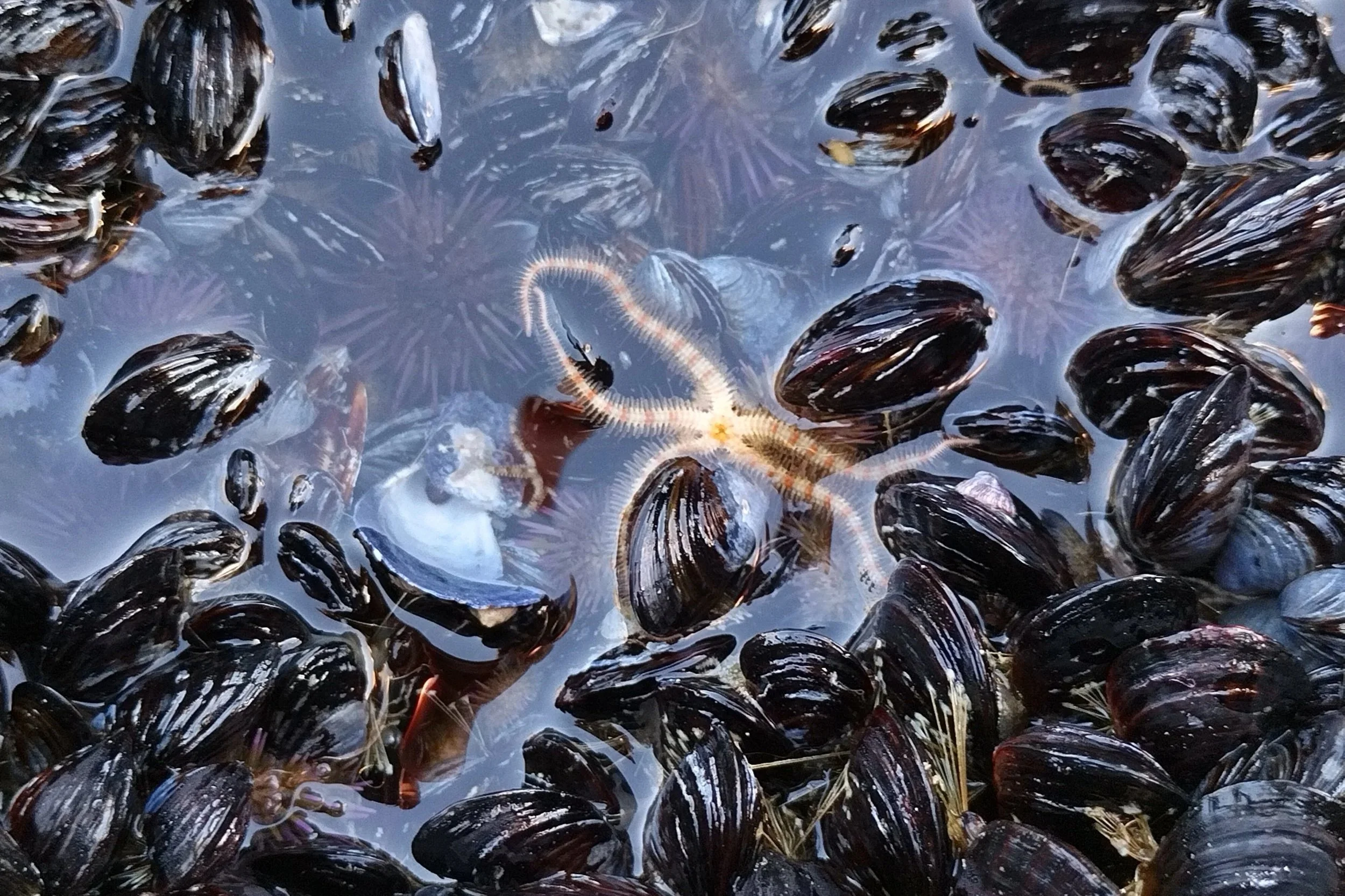
Brittlestar in a tidepool after sunset Photo by Agota Jonas
How does the brittle star sense light?
The brittle star's light-sensing system is built from three primary components working together.
The outer surface of each dorsal arm plate contains a dense array of microscopic single-crystal calcite lenses. These tiny lenses collect and focus incoming light onto bundles of photosensitive nerve cells located just beneath them.
The third component is a network of specialized pigment cells called chromatophores. During daylight, these pigment cells spread beneath the surface, shielding the light-sensitive nerve bundles from excessive light. As darkness falls, the pigment retracts into narrow channels between the lenses, allowing much more light to pass through. By regulating the amount of incoming light, the brittle star responds to changing light conditions throughout the day.
Together, these three components provide the brittle star with enough visual information to detect changes in light and shadow and rapidly respond to potential threats. Rather than functioning as a single eye, the animal relies on a distributed network of microscopic optical units working together.
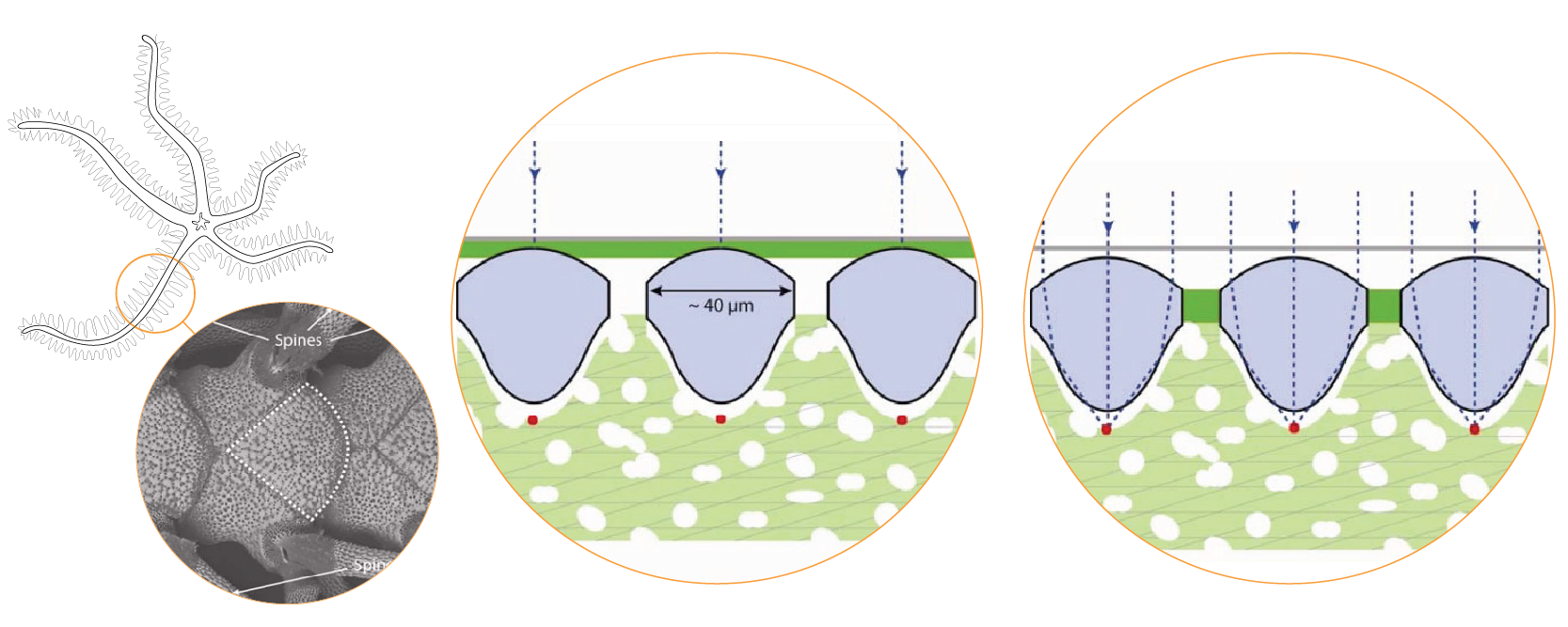
Illustration using images from Mineral Eyes, by Clare Torney, Univ. of Glasgow
Schematic cross-sectional view through the dorsal arm plate of a light-sensitive brittlestar. Migration of pigment cells (chromatophores) allows the animal to control the amount of light reaching the photoreceptors and so adapt itself to light and dark conditions. Blue dashed lines represent light rays. Images based on Aizenberg and Hendler.
The design lesson
By looking closely at the brittle star, we discover that nature rarely separates functions the way we do. Rather than treating optics, sensing, protection, and structure as independent systems, it integrates them into one elegant solution.
Perhaps this is the deeper lesson. In nature, remarkable performance often emerges not from adding more components, but from allowing many functions to work together as one integrated system.
The strategies combined here are:
· Microscopic calcite lenses collect and focus incoming light.
· Photosensitive nerve bundles detect the focused light.
· Responsive pigment cells regulate the amount of light reaching the receptors.
· Structural, optical, and sensing functions are in a single surface.
Sophisticated sensing, without increasingly sophisticated sensors.
Before asking how we might apply this strategy, could we first take a moment to appreciate how elegantly it works?
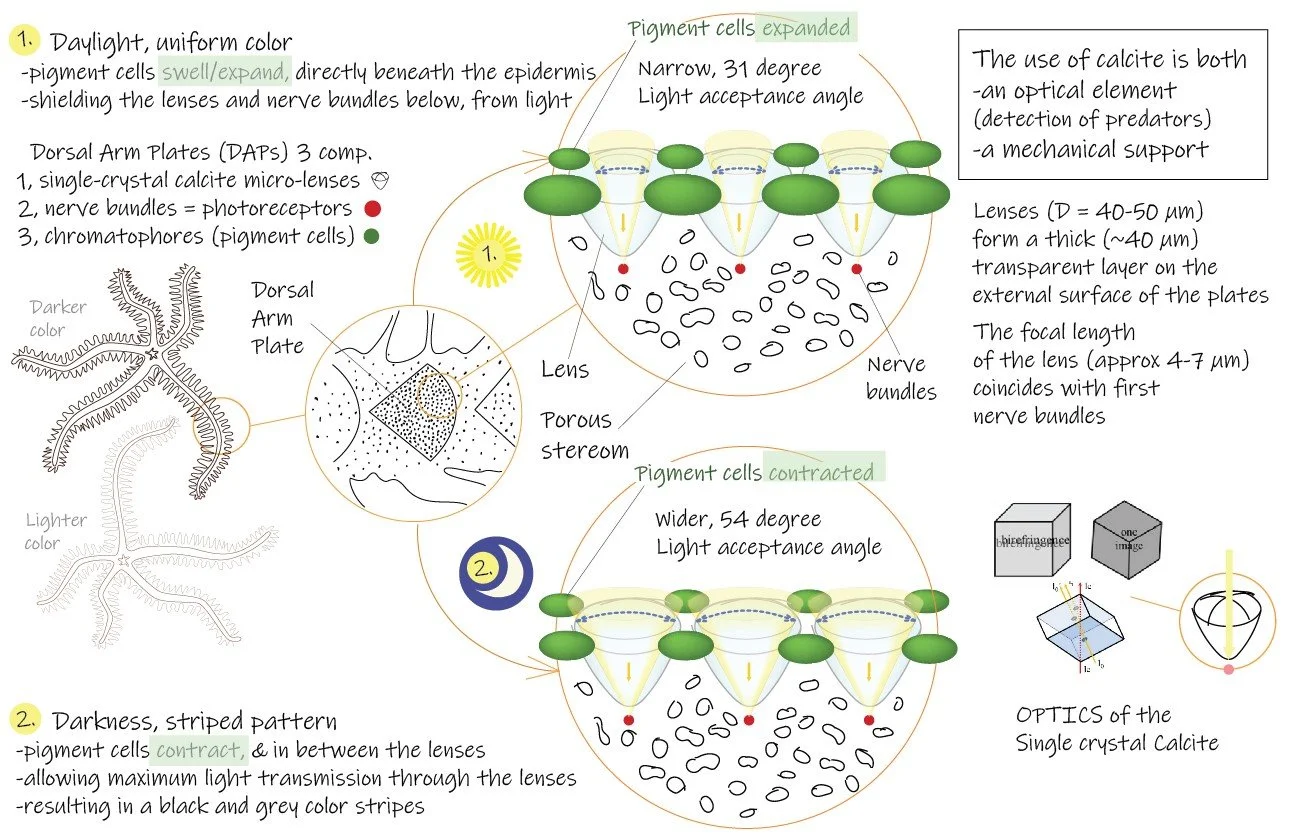
Drawing by Agota Jonas - Sharing Nature’s Genius
Can we mimic this strategy?
The brittle star has been quietly refining this remarkable way of sensing light for millions of years. Long before humans developed cameras, optical sensors, or smart materials, life had already found another way to accomplish the same function.
We naturally want to ask how these strategies might inspire new ideas. That curiosity is at the heart of biomimicry.
For example, could building facades regulate incoming sunlight using microscopic optical structures instead of mechanical blinds? Could materials passively adapt to changing light conditions without motors or electronics? These are fascinating questions, and they are certainly worth exploring.
But perhaps they are not the only questions worth asking.
What kind of students do we want to be? Students who look for ideas to borrow, or students who first seek to understand?
If we approach organisms simply as sources of ideas, we risk overlooking something much more valuable. Can we learn from nature not only by studying its strategies, but also by appreciating the millions of years of experimentation, adaptation, and refinement behind them?
Each organism is the result of that long evolutionary journey.
The brittle star invites us to imitate, but also to do more than imitate. Perhaps the greatest lesson nature offers is not just how to solve a problem, but how much there is still to learn – and to see.
References
Aizenberg, J., Tkachenko, A., Weiner, S., Addadi, L., & Hendler, G. (2001). Calcitic microlenses as part of the photoreceptor system in brittlestars.
Aizenberg, J., & Hendler, G. (2004). Biological and structural aspects of brittle star calcitic microlenses.
Torney, C. (2011). Mineral Eyes: Lessons from the Natural World (Doctoral dissertation, University of Glasgow).
Hendler, G. (1984). Studies on light-sensitive brittle stars and chromatophore responses.
Hendler, G., & Byrne, M. (1987). Research on the visual system and pigment migration in brittle stars.
