

When Beauty Isn’t Enough
For years, the work of Zaha Hadid has inspired admiration. Her fearless rejection of the orthogonal grid, her fluid forms that seem to defy gravity, and her insistence that architecture could capture the dynamism of natural forces all resonate with a deep fascination for nature’s patterns and organic geometries. It is easy to assume that buildings which flow like water, twist like vines, and undulate like desert dunes embody nature’s intelligence. Yet a closer look at how these projects perform in terms of material demands, energy consumption, and relationship to local context reveals a crucial distinction: the work is inspired by nature’s aesthetics but rarely follows nature’s logic.
The Heydar Aliyev Center in Baku, Azerbaijan (2012) is breathtaking; its sweeping white curves genuinely feel alive. Yet constructing it required specialized materials and complex engineering. The London Aquatics Centre for the 2012 Summer Olympics faced criticism for using more than 3,000 tons of steel in its roof, which critics argued was excessive compared to similar-sized structures. While Hadid’s later career showed increasing attention to sustainability, and her firm developed strategies using simulation tools, her earlier iconic works often prioritized formal expression over environmental performance.
Nature works differently. A desert organism can never afford to merely “appear” resilient; it sources materials locally, minimizes resource use, responds to microclimate conditions, and integrates with existing systems. Hadid’s early buildings achieve a form of shallow biomimicry while sidestepping the functional principles that make natural systems resilient and efficient. They are compelling metaphors for nature, but they do not function as part of a living ecosystem.
This distinction becomes clearer when viewed alongside architects whose work aligns both poetically and functionally with living systems. Glenn Murcutt’s Australian houses are radically attuned to their specific sites, responding to landscape and climate with materials selected for their energy impact. Shigeru Ban has pioneered structural systems using cardboard tubes and bamboo, creating disaster relief shelters that are both elegant and materially efficient. Anna Heringer’s work in Bangladesh uses rammed earth and bamboo to create community buildings that rely on local labor and techniques, strengthening rather than extracting from the places they inhabit.
These examples demonstrate that beauty and ecological intelligence are not opposing goals. When design draws from nature’s principles rather than its forms alone, a different kind of beauty emerges.
Hadid’s legacy remains important; she expanded the architectural imagination, encouraging designers to move beyond rigid geometries and engage with organic complexity. But as the field moves toward genuinely life-centered design, the question shifts from “does it look like nature?” to “does it function like nature?”
That deeper inquiry into material cycles, local integration, adaptive resilience, and efficient multifunctionality opens up a richer design practice; one where buildings are not isolated objects, but participants in living systems. Here, biomimicry moves beyond appearance and becomes a way of creating things that behave like nature: responsive, efficient, and inherently part of larger ecosystems.
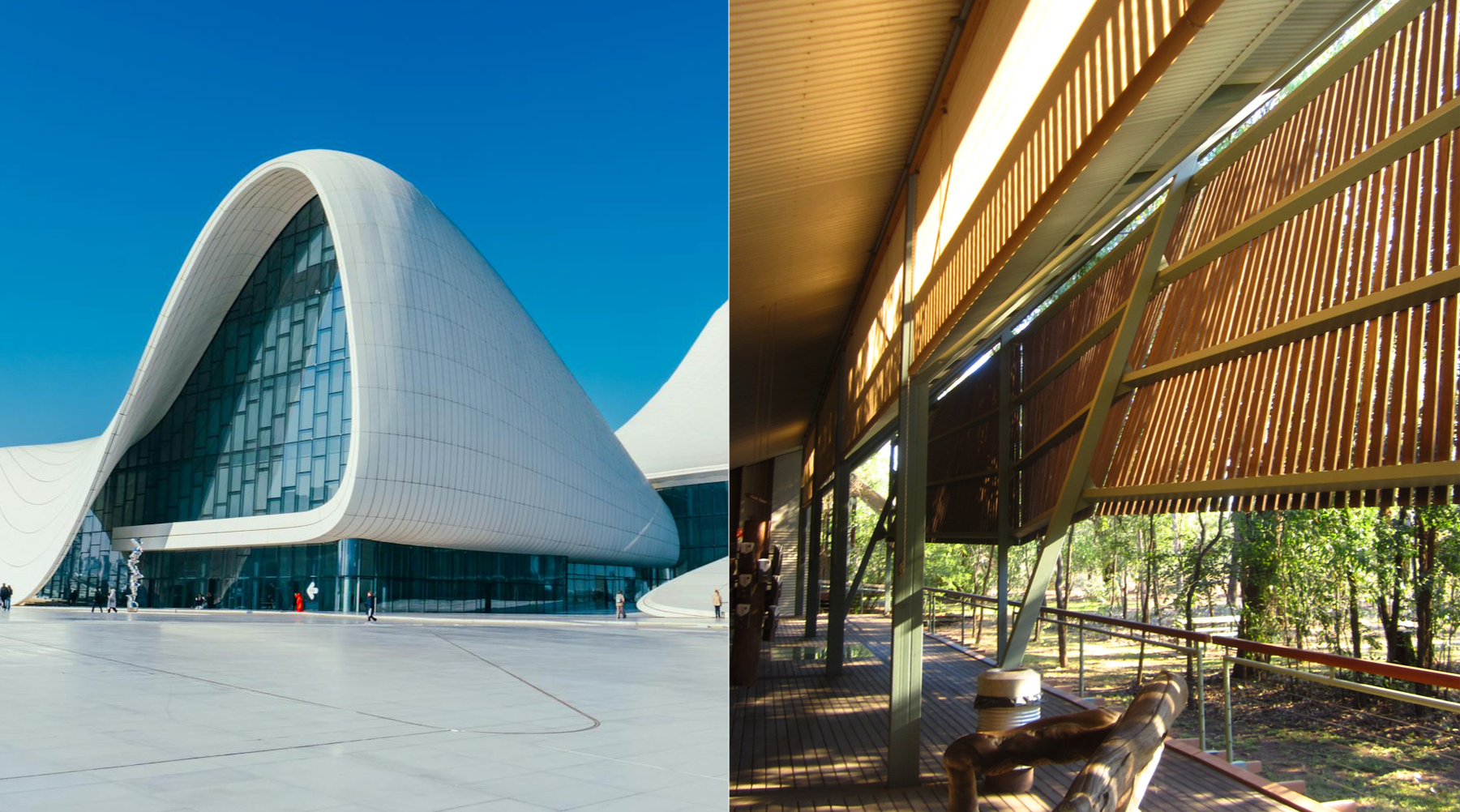
The Heydar Aliyev Center by Zaha Hadid & Kakadu Visitor Centre, designed by Glenn Murcutt (Photo Credit: Luke Durkin)